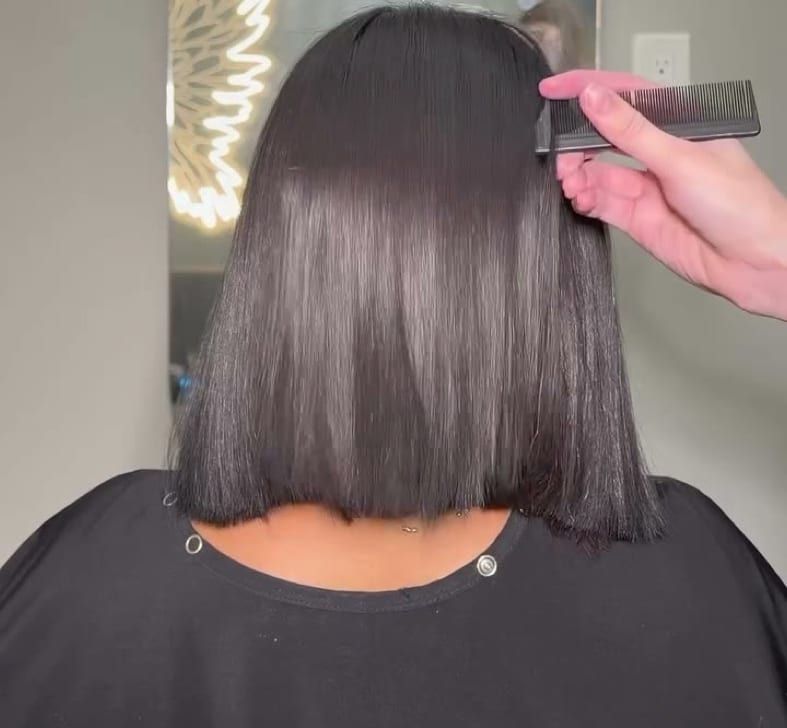
No smoothing treatment suits every head, and whether nanoplasty is right for you depends on the condition of your hair and scalp. At kruLA a specialist looks at both before the treatment, and the session is 3 h to 4 h.
kruLA does nanoplasty in Century City for $220 to $550, by hair length: call (949) 883-8301.
Does nanoplasty damage hair?
Any straightening service that uses chemical products and heat can damage hair that is already fragile, and nanoplasty is a strong one, which is why the hair is assessed first.
Nanoplasty smooths hair and makes it look healthier, but it is not a repair treatment. If your hair is brittle, bleached or breaking, a repair step such as cold hair recovery can come first.
What are the side effects of nanoplasty?
The side effects people report with smoothing treatments in general are scalp or skin irritation, dryness, a stiff or flat look and a product smell for a short time.
If you notice a reaction on the scalp, tell the studio at (949) 883-8301 and see a doctor if it is severe.
- Scalp or skin irritation.
- Dry or stiff-feeling hair.
- A flatter look at the roots.
- A product scent that fades with washing.
What are the disadvantages of nanoplasty?
The disadvantages are that it changes the texture of the treated length for a stretch, the roots grow in with your natural texture, and it needs aftercare.
It is also one of the longer sessions at 3 h to 4 h. If you want to keep your curls, ask about hair botox or a silk press instead.
Does hair fall after nanoplasty?
Everyone sheds hair every day, and combing freshly smoothed hair can make that shedding easier to see.
Hair that snaps along the length is breakage, not shedding. If you notice either one after the treatment, tell the specialist.
Is nanoplasty safe for hair loss?
Nanoplasty does not treat hair loss, and if you are losing hair the first step is to find the cause, which is a medical question.
The American Academy of Dermatology explains the common causes and when to see a dermatologist: AAD: hair loss. A kruLA consultation looks at your hair and scalp to choose a treatment; it does not diagnose medical conditions.
Can nanoplasty grow hair?
No: nanoplasty smooths hair that has already grown and does not make hair grow.
It also does not stop hair from falling out. Hair growth and hair loss are questions for a dermatologist.
What goes wrong when people report a bad nanoplasty result?
The problems people describe are dry or brittle ends, a flat look, uneven straightness and hair that was already damaged before the treatment.
The way to lower the risk is to book a consultation, be exact about what has been done to your hair, and follow the aftercare. Three months on, check whether the ends are dry and how the roots are growing in, and ask the specialist if anything looks wrong.
What should I ask before booking nanoplasty?
Ask what product is used, what is in it, how the hair will be prepared and what aftercare to follow.
- The product name and its ingredient list.
- Whether your hair history affects the treatment.
- How thickness changes the price and the session length.
- What to avoid and what to buy afterwards.
What drives the price of nanoplasty? Hair length and hair thickness set the price: at kruLA nanoplasty runs from $220 for shoulder length and shorter to $550 for butt length and longer, and high density adds $30 to $90.
Thickness is measured before the treatment, and the session takes 3 h to 4 h depending on length. Every length step is on the prices page, and the nanoplasty page has the booking button.
Nanoplasty safety FAQ
Is nanoplasty safe?
Safety depends on the match between the treatment and your hair and scalp, on the product used and on a trained specialist applying it. Ask for the product name and safety data sheet, and tell the specialist about sensitivities.
Is nanoplasty safe for hair?
It is meant for hair healthy enough for heat, which is why the hair is assessed first. Nanoplasty smooths and straightens; it is not a repair treatment.
Is nanoplasty bad for hair?
Heat and chemical products can damage hair that is already fragile, so the hair is assessed first. If it is brittle or breaking, a repair step such as cold hair recovery can come first.
Does nanoplastia damage hair?
It can on fragile hair, which is why the specialist looks at the hair and scalp first. Tell the specialist about past relaxers, lightening and smoothing treatments.
Can a nanoplasty damage your hair?
Heat and chemical products can damage hair that is already fragile, so a specialist looks at the hair first. Nanoplasty does not repair damage.
What are the side effects of nanoplasty?
People report irritation of the scalp, skin or eyes, a headache or an unpleasant smell during the visit, and dry or stiff-feeling hair. If you notice a reaction, tell the studio at (949) 883-8301, and see a doctor if it is severe.
Does hair fall after Nanoplastia?
Shedding and breakage are different problems. Combing freshly straightened hair can make normal shedding easier to see; ongoing hair loss is a question for a dermatologist.
Does nanoplastia stop hair fall?
No: a nanoplasty smooths hair and is not a treatment for hair fall. Smoother hair can break less, so the length you have can look better kept; see a dermatologist for hair loss.
Is nanoplasty safe for hair loss?
Hair loss is a medical question for a dermatologist, and nanoplasty is not a hair-loss treatment. Tell the specialist about hair fall before booking.
Can nanoplasty grow hair?
No: nanoplasty works on hair that has already grown and does not change how fast it grows. Hair growth is a question for a dermatologist.