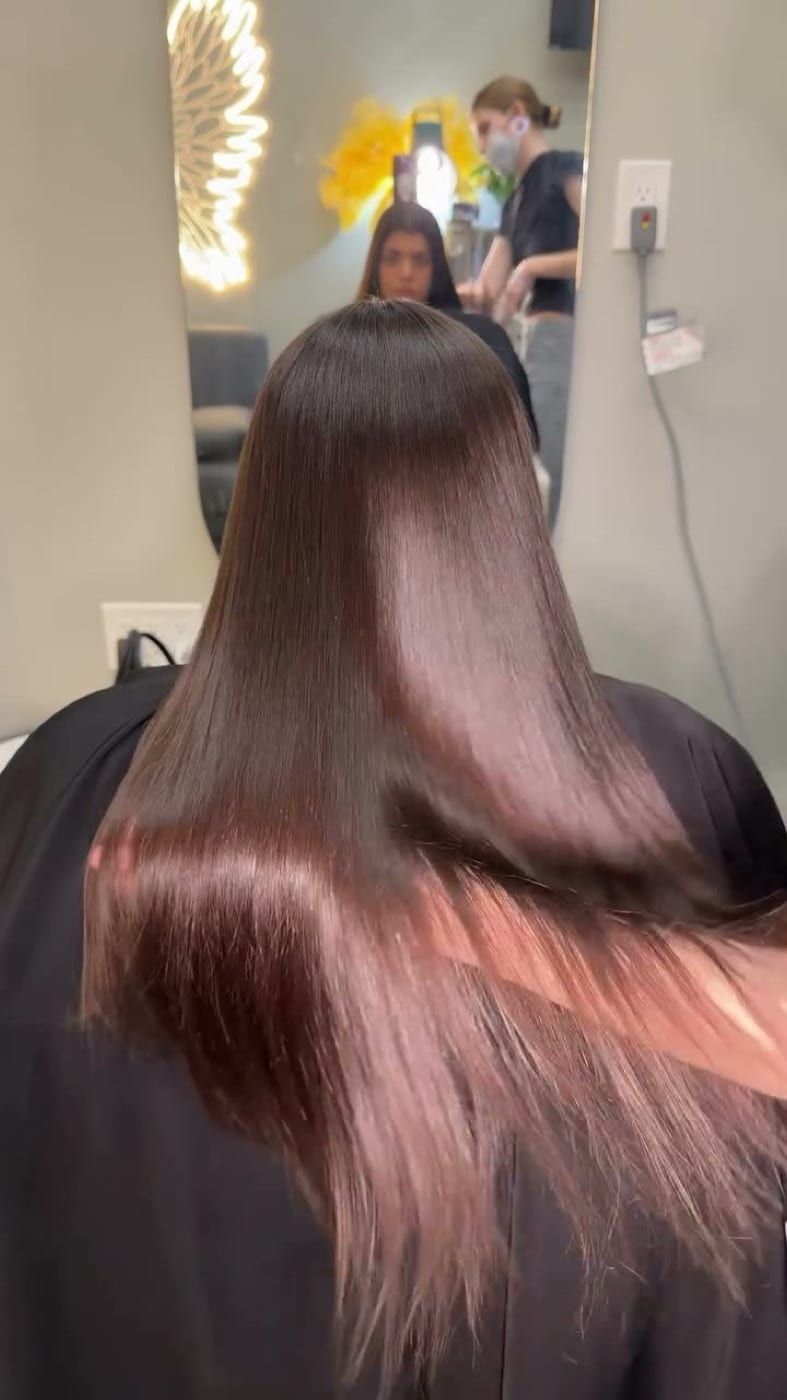
A keratin treatment is used on many hair types, and what you tell the specialist about your hair history decides how it goes. This guide covers curly, thin, Black, gray, bleached and short hair, and how hair color fits around the treatment.
kruLA does keratin treatment in Century City for $220 to $550, by hair length: call (949) 883-8301.
Which hair type is best for keratin treatment?
Frizzy, wavy and loosely curly hair gets the most visible change, and the result differs by texture.
Straight hair gets smoother and shinier, curly hair gets looser and less frizzy, and very tight coils change the least, which is where nanoplasty comes in.
Does one keratin formula work on all hair types?
No single formula suits every head: the product, the strength and the timing are chosen for the hair in the chair.
The specialist tells you what to expect for your hair at the consultation.
Can you get a keratin treatment on curly hair, and what should you expect?
Yes: it loosens and smooths curls and cuts frizz, and the pattern comes back gradually as the product fades.
To keep your curls and cut the frizz, ask about hair botox. For the care that follows, see living with keratin.
Does keratin damage curly hair?
Not by itself: damage comes from heat and chemicals on fragile hair, which is why the hair is assessed first.
Repeated treatments on dry curly hair can loosen the pattern, so keep the hair moisturised and tell the specialist how often it has been smoothed.
Which keratin treatment suits Black hair?
It depends on the texture and what you want: keratin smooths and loosens, and nanoplasty is the stronger straightening for afro curls and tight coils.
At kruLA the specialist looks at the hair first. The difference is set out in nanoplasty vs keratin.
Is a keratin treatment good for thin hair?
It can be, and the specialist checks the hair first; the thing to know is that fine hair can look flatter once the frizz is gone.
If you want to keep lift at the roots, say so at the consultation: kruLA's keratin treatment is BIO keratin, described as keeping natural volume.
Is a keratin treatment good for gray hair?
Yes: gray hair is often coarse and frizzy, and smoothing makes it easier to manage.
Tell the specialist how the hair has been colored before the treatment.
Does keratin work on short hair?
Yes, and short hair is the shorter end of the visit: at kruLA the price steps start at shoulder length and shorter, at $220.
Short hair gets the same smoothing, applied to less length. Every step is on the prices page.
Which keratin treatment suits frizzy hair?
Frizzy hair is what a keratin treatment is made for, and the specialist matches the treatment to how coarse and how curly the hair is.
The consultation is where that match is made.
Can you do a keratin treatment on colored hair?
Usually yes, after the specialist has seen the hair, because colored hair can be more fragile and take the product unevenly.
Tell the specialist what was done and when. Smoothing can also fade the shade a little, which is worth raising with your colorist.
Can I color my hair after a keratin treatment?
Ask your specialist and your colorist before you book anything, because heat, chemicals and timing interact.
Brands typically give a waiting period around a smoothing treatment, and the timing depends on the product used.
Can I color my hair before or after a smoothing treatment, or on the same day?
Decide the order with your colorist and the specialist, not on your own: heat and smoothing products can shift the shade a little, most often in hair that has been lightened.
If both are planned for one day, the wash wait of the smoothing treatment decides when you can shampoo, so ask both before booking.
What hair color should I use after a keratin treatment?
There is no single color rule: ask your colorist for gentle, ammonia-free options and keep the products you use at home sulfate-free.
To cover gray, plan the visit with your colorist and tell them about the smoothing. If a color result looks wrong, go back to the colorist who did it.
Can you bleach hair after a keratin treatment?
Sometimes, and only with a professional who has seen the hair: bleaching is a harsh step, and smoothed hair that is then lightened can become fragile.
Tell both professionals what has been done and when. If the hair feels dry or starts to break, a repair step such as hair reconstruction can come first.
Can I get a keratin treatment after bleaching my hair?
Sometimes, after the specialist has seen the hair: bleached hair is more fragile and takes product unevenly.
Tell the specialist how the hair was lightened and when. If it is dry or breaking, a repair step such as cold hair recovery can come first.
Can a keratin treatment be used on henna-dyed hair?
Tell the specialist before booking, because henna coats the hair and some henna products contain metallic salts that can react with chemicals.
The specialist decides after seeing the hair; do not combine them on your own.
What drives the price of a keratin treatment? Hair length and hair thickness set the price: at kruLA a keratin treatment runs from $220 for shoulder length and shorter to $550 for butt length and longer, and thick hair adds $30 to $50.
Thickness is measured before the treatment, and the session takes 2 h to 3 h 30 min depending on length. Every length step is on the prices page, and the keratin treatment page has the booking button.
Keratin and hair types FAQ
Is keratin treatment good for grey hair?
Yes: gray hair is often coarse and frizzy, and smoothing makes it easier to manage. Tell the specialist what has been done to the hair before the treatment.
Does keratin treatment work on grey hair?
Yes, and the specialist looks at it first because gray hair can be wiry. The treatment smooths the surface.
Is keratin ok for curly hair?
Yes: it loosens and smooths curls and cuts frizz, and the pattern relaxes. To keep your curls and cut the frizz, ask about hair botox.
Does keratin damage curly hair?
Not by itself. Repeated treatments on dry curly hair can loosen the pattern, so keep the hair moisturised and tell the specialist how many times it has been smoothed.
What is keratin treatment for black hair?
It depends on the texture and what you want: keratin smooths and loosens, and nanoplasty is the stronger straightening for afro curls and tight coils. The specialist looks at the hair first.
Can you get a keratin treatment on coily 4c hair?
Yes, keratin loosens and smooths coils; for coils you want pin-straight, nanoplasty is the stronger option. The specialist looks at the hair first.
Which hair type is best for keratin treatment?
Frizzy, wavy and loosely curly hair gets the most visible change; very tight coils change the least, which is where nanoplasty comes in. The specialist tells you what to expect for your hair at the consultation.
Will a keratin treatment straighten my curls?
It loosens and smooths curls and cuts frizz; how straight the hair ends up depends on the texture. For pin-straight, kruLA uses nanoplasty.
Does keratin treatment work for thin hair?
It can, and the specialist checks the hair first. Fine hair can look flatter once the frizz is gone, and BIO keratin keeps natural volume.
Will keratin treatment make fine hair flat?
It can: smoothing takes down puffiness, so fine hair can look flatter. If volume at the roots matters, say so at the consultation and ask about BIO keratin.
Does one keratin formula work on all hair types?
No single formula suits every head: the product, the strength and the timing are chosen for the hair in the chair. The specialist tells you what to expect at the consultation.
Why do some colorists say no to keratin on blonde hair?
Lightened hair is more porous and takes heat differently, so some colorists want it checked before any smoothing treatment. The kruLA specialist checks a strand at the consultation ($0), and the order of the two services is agreed between you, your colorist and the specialist. Tell the specialist how and when the hair was lightened.