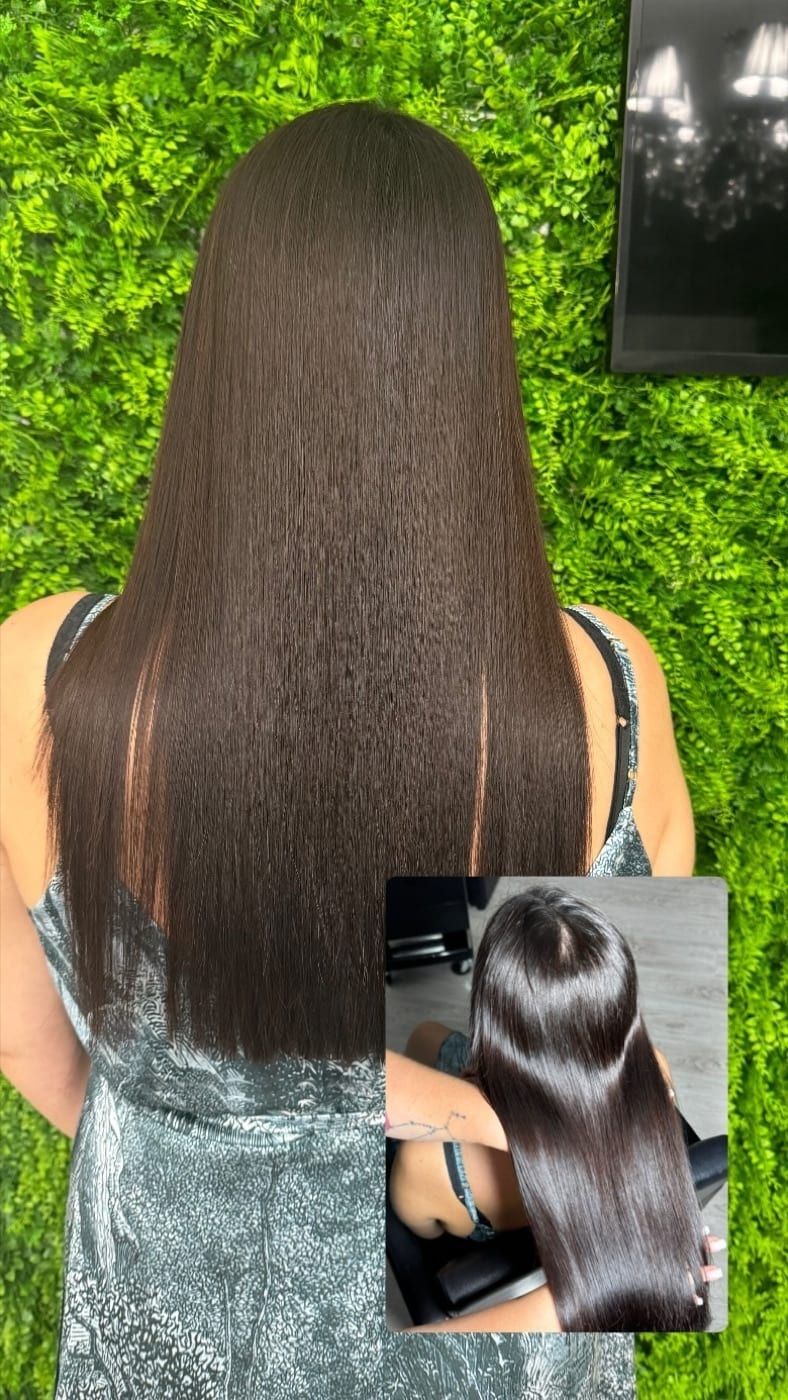
Smoothing treatments coat and smooth the outside of the hair and fade with washing, a silk press stretches the hair with heat until the next wash, and chemical straighteners change the hair's internal bonds and stay on the treated length. At kruLA the smoothing treatments are keratin, nanoplasty and hair botox, and the comparisons set them side by side.
kruLA does keratin treatment in Century City for $220 to $550, by hair length: call (949) 883-8301.
| Method | How it works | What you see | Offered at kruLA |
|---|---|---|---|
| Hair botox | A conditioning and smoothing treatment applied to the strand | Softer, shinier, less frizz; waves relax a little and tight curls stay curly | Yes |
| Keratin | A smoothing product applied to the hair and sealed with heat | Smoother hair with less frizz; the effect fades gradually | Yes, as BIO keratin |
| Brazilian Blowout | A brand smoothing product applied to the hair and sealed with heat | Smoother and straighter hair; the effect fades gradually | Yes |
| Nanoplasty | A smoothing treatment that straightens more than keratin | Straight, sleek hair, including thick hair and tight coils; fades gradually | Yes |
| Silk press | Blow-dry and flat iron, with no chemical straightener | Straight hair until the next wash | Yes |
| Japanese straightening, rebonding | A chemical straightener that changes the hair's bonds, then a flat iron | Straight treated hair; new growth comes in natural | No, explainer only |
| Relaxer | A chemical straightener applied to the roots and the length | Straight treated hair; new growth comes in natural | No, explainer only |
What types of permanent hair straightening treatments are there?
There are three: Japanese straightening (also called thermal reconditioning), rebonding, and relaxers, and all three are chemical straighteners that change the hair's internal bonds.
They are called permanent because the straightening stays on the hair that was treated until that hair grows out or is cut off. kruLA does not offer any of them; the Japanese straightening, relaxers and rebonding guide explains each one.
- Japanese straightening and rebonding: a reducing lotion softens the bonds, the hair is flat-ironed straight and a neutralizer sets it.
- Relaxers: a strong alkaline cream is applied to the hair and rinsed out once the hair is straight.
- Everything else on this page, including the treatments at kruLA, is a smoothing treatment or a heat style and fades.
What is the chemistry of why smoothing treatments work?
Hair is mostly keratin protein, and its shape comes from bonds between the protein chains: water and heat move the weak ones, which is why a blow-dry works until the next wash, and the strong ones, which only a chemical straightener changes.
Smoothing treatments work from the outside: a product is applied, dried and sealed with a flat iron, and it fills and smooths the surface so the strand lies flat and frizzes less. Because it sits on the hair instead of rebuilding its bonds, it fades as the hair is washed and brushed.
Is keratin the main smoothing ingredient, and is cysteine better for dry, frizzy hair?
Many smoothing products are keratin-based, but the name on the treatment does not tell you what is in the bottle, so ask for the product name and its ingredient list.
Cysteine is an amino acid that keratin protein is rich in, and a cysteine treatment is another name for a smoothing or conditioning product. For dry, frizzy hair neither name wins on its own: choose by the job. Hair botox softens and cuts frizz, keratin straightens, and very dry or brittle hair may need cold hair recovery first.
What is the difference between a smoothing treatment and a keratin treatment?
Smoothing treatment is the wider name, and a keratin treatment is one kind of it.
Hair botox, keratin, Brazilian Blowout and nanoplasty are all smoothing treatments; they differ in how much they straighten and how they treat the hair. See keratin vs Brazilian Blowout for the two that are separate services at kruLA.
What is the difference between hair botox, keratin and nanoplasty?
Hair botox smooths and softens and keeps your wave, keratin tames frizz and keeps root volume, the Brazilian blowout straightens and strengthens, and nanoplasty is the strongest straightening, for thick hair and tight coils.
Pick the result you want: smoother and softer with your texture kept, straight, or straight on the hardest texture. The pairs have their own pages: hair botox vs keratin, nanoplasty vs keratin and nanoplasty vs hair botox.
What is the difference between keratin, Brazilian Blowout and hair botox?
Brazilian Blowout is a brand of smoothing treatment, keratin is the wider kind, and hair botox is the one that smooths without straightening.
At kruLA the keratin treatment is BIO keratin and the Brazilian blowout is a separate service done with the Brazilian Blowout product, each with its own price.
What is the difference between nanoplasty, Japanese straightening and a perm?
Nanoplasty is a smoothing treatment that fades, and Japanese straightening and a perm are chemical services that change the hair's bonds.
A perm and Japanese straightening use the same idea in two directions: a reducing lotion softens the bonds, the hair is shaped, and a neutralizer sets the new shape. A perm sets curls on rods, and Japanese straightening sets the hair flat after a flat iron. kruLA does not offer a perm or Japanese straightening.
What is the difference between rebonding and smoothing?
Rebonding changes the hair's bonds and stays on the treated length, and smoothing coats the outside of the hair and fades.
That is why rebonding leaves a visible line where straight treated hair meets natural new growth, and smoothing grows out gradually. kruLA does not offer rebonding.
What is the difference between a taming system and other hair straightening treatments?
A taming system is a marketing name, not a method, so it can mean anything from a conditioning smoothing treatment to a straightener.
The same goes for any product name on a menu: the name does not tell you the chemistry. Ask what the product does to the hair, whether it changes the bonds or only coats the surface, and read the ingredient list before you book.
What are the pros and cons of permanent hair straightening?
The pro is straight hair with little daily styling, and the cons are root regrowth, a harsher process and a result you cannot reverse.
The cons in detail: new growth comes in natural, so the roots need touching up and the join between treated and new hair is a weak point; dryness and breakage are risks, most of all on hair that is already damaged or lightened; and the straightening cannot be undone, only cut or grown out.
How long does permanent hair straightening last?
Chemical straightening stays on the treated hair until that hair is cut off, and the new growth is not straightened.
Smoothing treatments fade gradually, and brands typically quote their results in months. For your own hair, the consultation is where a specialist tells you what to expect.
Is chemically straightened hair different to work with?
Yes: chemically straightened hair has had its bonds changed, so it behaves as straightened hair on the treated length and as natural hair at the roots.
Tell the specialist about every chemical service you have had before booking a smoothing treatment, because a smoothing treatment on top of a chemical straightener or on very damaged hair is a decision for the specialist after looking at the hair.
What happens to hair texture after smoothing?
Hair looks and feels smoother, curls loosen, and volume goes down; how much changes depends on the treatment and your hair.
Hair botox softens waves and keeps tight curls, keratin loosens the pattern more, and nanoplasty straightens the most. As the smoothing fades, your natural texture comes back gradually, and new growth shows it first at the roots.
What are the heat-free straightening methods?
Heat-free methods stretch the hair while it dries, for example wrapping or banding damp hair, and the effect is short-lived; relaxers straighten without heat, but they are chemical.
The smoothing treatments on this page use heat to set the product, and a silk press is a heat style. If you want to avoid heat altogether, ask for cold hair recovery, a repair treatment that is not a straightening.
What are the other hair straightening options?
Beyond the treatments above there are flat-iron and blow-dry styling, and the choice is between a style that lasts until the next wash and a treatment that stays through washing.
A silk press is the heat style at kruLA. Silk press: heat-only straightening covers it, and which smoothing method for which hair type helps you choose.
What drives the price of a smoothing treatment?
Hair length and hair thickness set the price: at kruLA keratin is $220 to $550, nanoplasty is $220 to $550 and hair botox is $200 to $450, and thick hair adds $30 to $50 on keratin and $30 to $90 on the others.
Thickness is measured before the treatment, and a silk press is $95 to $140 by curl pattern. Every length step and session time is on the prices page, and the consultation is $0 for 20 min.
Straightening types FAQ
What happens during the hair smoothing process?
The specialist looks at the hair and measures its thickness, the hair is washed, the product is applied section by section and left to work, then the hair is dried and sealed with heat and finished. The exact steps depend on the product used.
Does hair smoothing mask need heat from a blow dryer?
Many smoothing systems are dried and sealed with heat in the chair, and the system decides the steps. Ask the specialist for the steps of the product used.
Does a hair smoothing product work if hair air dries?
Most smoothing products are made to be set with heat in the salon; the system decides, so follow the instructions for the product used. Ask the specialist for the steps of the product used.
Is smoothing fluid used before blow drying?
Some systems use a smoothing fluid before drying and others do not; it depends on the system. Ask the specialist for the steps of the product used.
Is btx a hair straightener?
BTX is a marketing name for a smoothing and conditioning treatment, similar to hair botox, that smooths and softens. It does not straighten tight curls.
Should I do the smooth or moist treatment?
Smooth is for frizz that you want gone, and moist is for dry hair that needs conditioning. The consultation ($0) says which your hair needs.
How soon can I wash my hair after a smoothing treatment?
Brands typically ask you to wait several days before the first wash, and your specialist gives you the exact wait for the product used. Follow the sheet.
Can I swim in chlorine or the ocean after a smoothing treatment?
Not during the wait, and afterwards with care: chlorine and salt water dry the hair. Wet the hair with fresh water first and rinse and condition right after.
How to use a mask after smoothing can conditioner follow?
Yes: use a light mask after shampooing, leave it for the time its label gives, rinse well and follow with conditioner if the hair needs it. Ask the specialist which suits your hair.
What is the difference between a taming system and other hair straightening treatments?
"Taming system" is a marketing name for a smoothing treatment. The method behind it varies; compare the product, the steps and the specialist, not the name.
What should I do after hair straightening?
Follow your specialist's sheet: keep the hair loose during the wait, wash with a sulfate-free shampoo afterwards and keep heat low. Ask the specialist for the exact wait.