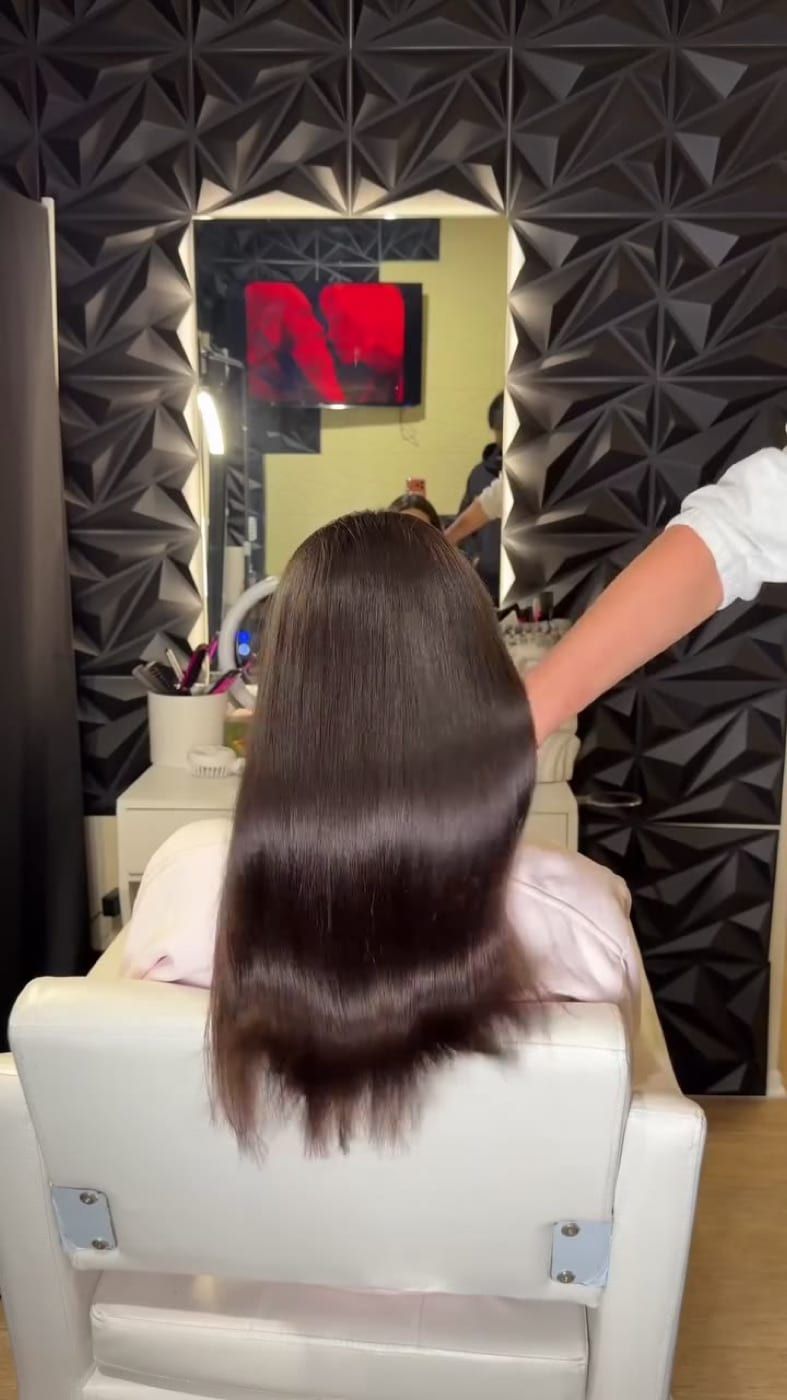
Japanese hair straightening is a chemical service that straightens hair by changing its internal bonds, and the straightening stays on the treated hair until it grows out or is cut off. kruLA does not offer Japanese straightening, rebonding or relaxers; the straightening services here are keratin, nanoplasty and the heat-only silk press.
kruLA does keratin treatment in Century City for $220 to $550, by hair length: call (949) 883-8301.
| Method | What it does | Treated hair | Offered at kruLA |
|---|---|---|---|
| Japanese straightening | A reducing lotion softens the bonds, a flat iron straightens, a neutralizer sets | Stays straight; new growth comes in natural | No, explainer only |
| Rebonding | The same idea as Japanese straightening, under another name | Stays straight; new growth comes in natural | No, explainer only |
| Relaxer | A strong alkaline cream straightens the bonds | Stays straight; new growth comes in natural | No, explainer only |
| Keratin and nanoplasty | A smoothing treatment sealed with heat | Fades gradually | Yes |
| Silk press | Blow-dry and flat iron | Straight until the next wash | Yes |
What is Japanese hair straightening?
Japanese hair straightening, also called thermal reconditioning, is a chemical straightening service: a reducing lotion softens the hair's bonds, the hair is blow-dried and flat-ironed pin-straight, and a neutralizer sets it in the straight shape.
It is not offered at kruLA. For straight hair here, see keratin vs Japanese straightening and the keratin service.
What do you need to know before Japanese hair straightening, and what is the process?
It is a long, multi-step service done on healthy hair: the process is a reducing lotion, a rinse, a blow-dry and flat-iron pass section by section, a neutralizer and a final rinse.
Salons typically do a strand test first and may decline hair that is heavily damaged, lightened or already relaxed. It cannot be reversed, so the decision is the one to take slowly.
What are the pros and cons of Japanese hair straightening?
The pro is very straight hair with little daily styling, and the cons are the dryness and breakage risk, the line of regrowth at the roots and the fact that it cannot be undone.
It also changes how the hair responds to later services, so each one needs a specialist's judgment.
Is Japanese hair straightening bad for your hair?
It can be: the process changes the hair's bonds, and hair that is dry, bleached or already chemically treated is the most likely to break.
Done on healthy hair by a trained specialist it is a known service, and when Japanese hair straightening goes wrong the usual signs are hair that feels brittle, snaps at the join with new growth or has gone limp. A strand test and an honest hair history reduce the risk.
How long does Japanese hair straightening last?
On the hair that was treated it stays straight until that hair is cut off, and the new growth is not straightened.
Salons do root touch-ups as the natural texture grows in, and brands do not quote a single figure.
Can you undo Japanese hair straightening?
No product reverses it: the bonds were changed, and the only ways back to your natural pattern are cutting the straightened hair or growing it out.
Conditioning treatments can improve how the hair feels, and they do not restore the curl. Ask a specialist before adding anything else on top.
How do you grow out Japanese hair straightening?
Handle the join gently: the straightened hair and the natural new growth meet at a weak point where breakage is most likely.
Regular trims, gentle detangling, conditioning and avoiding more heat or chemicals help, and many people use protective styles to blend the two textures. The hair that was treated is trimmed off over time.
What is the difference between Japanese hair straightening and rebonding?
They are the same family of service: both change the hair's bonds, and the names differ by region and salon.
Rebonding is the usual name in much of Asia and Japanese straightening elsewhere. Ask what product is used and what the steps are, and do not rely on the name.
What is the difference between Japanese hair straightening and a relaxer?
A relaxer is a strong alkaline cream that straightens the hair without a flat iron, and Japanese straightening is a reducing lotion followed by a flat iron and a neutralizer.
Both stay on the treated hair and both leave new growth natural. Salons generally avoid applying one over the other, and kruLA offers neither.
What is better, Japanese or Brazilian straightening?
They are different things: Brazilian straightening is a smoothing treatment that fades, and Japanese straightening is a chemical service that stays on the treated hair.
If you want smoother, straighter hair that grows out gradually, ask about a Brazilian blowout or the keratin treatment. If you want the strongest straightening here, ask about nanoplasty.
Which is better, keratin or Japanese straightening?
Keratin is the gentler option, and Japanese straightening is the stronger and less reversible one; the better one is the one that suits your hair and tolerance for risk.
See keratin vs Japanese straightening for the comparison, and the consultation if you are not sure.
What is the difference between chemical straightening and keratin?
Chemical straightening changes the hair's bonds and stays on the treated hair, and keratin smooths the surface and fades gradually.
That is the whole difference: how deep the change goes and whether it reverses on its own.
What is the difference between a keratin treatment, a Brazilian Blowout and a relaxer?
Keratin and Brazilian Blowout are the same kind of smoothing treatment, and a relaxer is a chemical straightener.
At kruLA the keratin treatment is BIO keratin and the Brazilian blowout is a separate service. See BIO keratin vs Brazilian blowout.
Is a keratin treatment better than a relaxer?
They do different jobs: a relaxer loosens the treated hair for good, and a keratin treatment smooths and straightens it for a while and fades.
Choose keratin if you want to keep the option of going back to your natural texture, and note that nanoplasty is the stronger straightening if keratin is not enough.
What is the difference between a Brazilian Blowout and rebonding?
A Brazilian Blowout is a smoothing treatment that fades, and rebonding is a chemical straightener that stays on the treated hair.
Rebonding changes the bonds, and a Brazilian Blowout coats and smooths the surface.
What is the difference between a Dominican blowout and a keratin treatment?
A Dominican blowout is a heat style: the hair is washed, blow-dried and smoothed with a flat iron, and it holds until the next wash, while a keratin treatment is a product treatment that stays through washing and fades gradually.
kruLA does not offer a service under the name Dominican blowout; the silk press is the nearest heat style, and keratin is the treatment.
What is the difference between a silk press and a relaxer?
A silk press is heat only and straightens until the next wash, and a relaxer is a chemical that stays on the treated hair.
With a silk press your curl pattern returns when you wash, and with a relaxer it does not on the treated length. See the silk press guide.
What do people with coily hair use to straighten it?
The common choices are a silk press, which is heat only, and a relaxer, which is chemical; smoothing treatments such as nanoplasty and keratin are the third option.
A silk press is the way to try straight hair without a change that stays, and nanoplasty is the strongest straightening treatment at kruLA for tight coils.
What drives the price of a smoothing treatment? Hair length and hair thickness set the price: at kruLA keratin is $220 to $550, nanoplasty is $220 to $550 and hair botox is $200 to $450, and thick hair adds $30 to $50 on keratin and $30 to $90 on the others.
Thickness is measured before the treatment, and a silk press is $95 to $140 by curl pattern. Every length step and session time is on the prices page, and the consultation is $0 for 20 min.
Japanese straightening FAQ
What is the Japanese hair straightening method?
Japanese straightening uses a chemical to loosen the hair's bonds and a flat iron to set the new shape. kruLA does not offer it.
How much does Japanese hair straightening cost?
kruLA does not offer Japanese straightening, so it prints no price. Its straightening options are keratin ($220 to $550) and nanoplasty ($220 to $550).
What are the downsides of Japanese hair straightening?
The roots grow in with your natural texture and need touching up, the process is long and chemical, and it can damage fragile hair. kruLA does not offer it.
What is Japanese hair treatment?
Japanese hair treatment usually means Japanese straightening, a chemical straightening. kruLA does not offer it.
What is Japanese hair straightening?
Japanese straightening is a chemical straightening for very straight hair. kruLA does not offer it; for straight hair it offers keratin and nanoplasty.
Is Japanese hair straightening safe?
Safety depends on the product, your hair and a trained specialist; ask any salon for the product name and safety data sheet. kruLA does not offer it.
Is Japanese thermal straightening safe?
Thermal straightening uses heat and chemical to reshape the hair, and safety depends on the product and the hair. kruLA does not offer it.
Is Japanese hair straightening worth it?
It depends on your hair and your goal. kruLA does not offer it; keratin and nanoplasty are its smoothing and straightening treatments.
Should I get Japanese hair straightening?
Ask any salon about your hair history first, since chemically straightened hair needs care. kruLA does not offer it; keratin ($220) and nanoplasty ($220) are the alternatives.
How damaging is Japanese hair straightening?
It can damage fragile hair, so a salon looks at the hair first. kruLA does not offer it.
When Japanese hair straightening goes wrong?
Hair can be over-processed, lose its shape or break, which is why the hair is assessed first. kruLA does not offer it; call a salon that does for what to do.
What is the Japanese hair straightening process?
A multi-step process: the hair is washed, a chemical is applied and rinsed, the hair is flat-ironed section by section and set. kruLA does not offer it.
How long after Japanese straightening to wash hair?
Ask the salon that did it. kruLA does not offer it.
Can you use hair ties pins or clips after Japanese straightening?
Ask the salon that did it; in the first days the hair is usually kept loose. kruLA does not offer it.